Artists at Carmel
Joseph Szabó

Click image for larger view
Year: 1990s
Medium: Oil
Location: Carmelite Monastery Melbourne
Words from the artist:
“St Teresa is setting out with cart and mules, staff in hand, Avila in the background. The sun is setting and the storm clouds are gathering – we see the winds caught in her veil. She stands on the brink, on the verge of being pushed over the edge. But she is holding firm with determination and singleness of purpose, her gaze fixed ahead – on the Lord. “Let nothing disturb you…”.
Click image for larger view
Year: 1990s
Medium: Oil
Location: Carmelite Monastery Melbourne
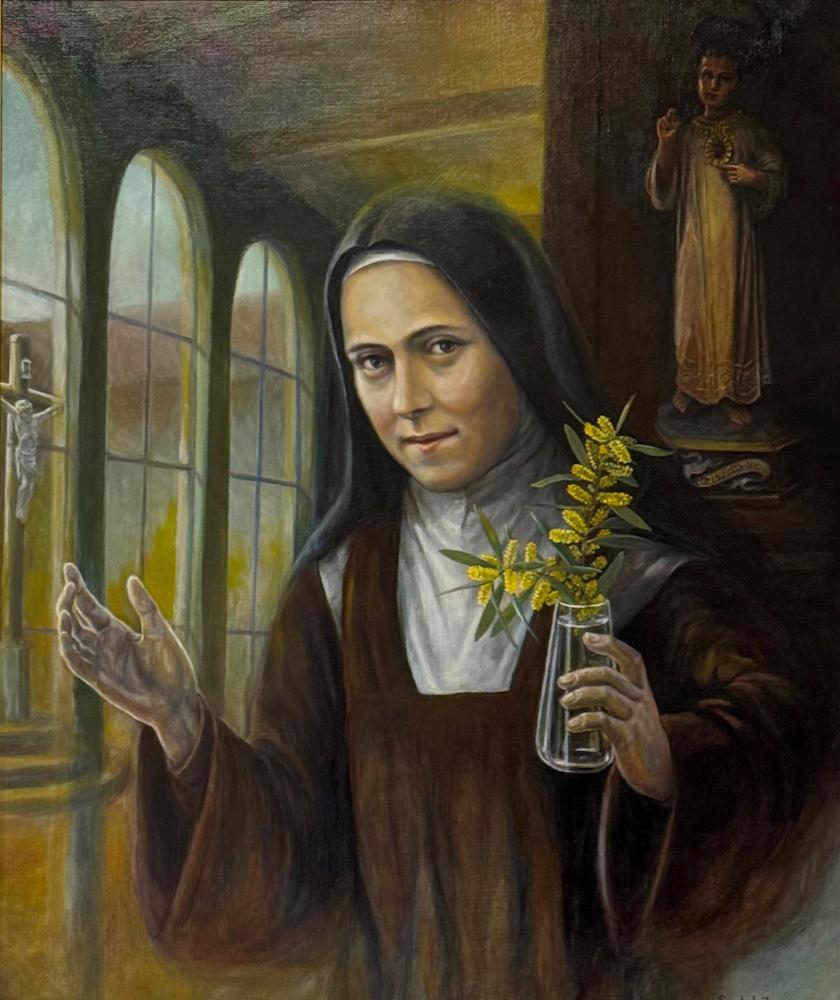
St Therese is depicted in this painting with golden wattle in a simple glass jar, the wattle being the floral emblem of Australia.
Click image for larger view
Year: 1990s
Medium: Oil
Location: Carmelite Monastery Melbourne
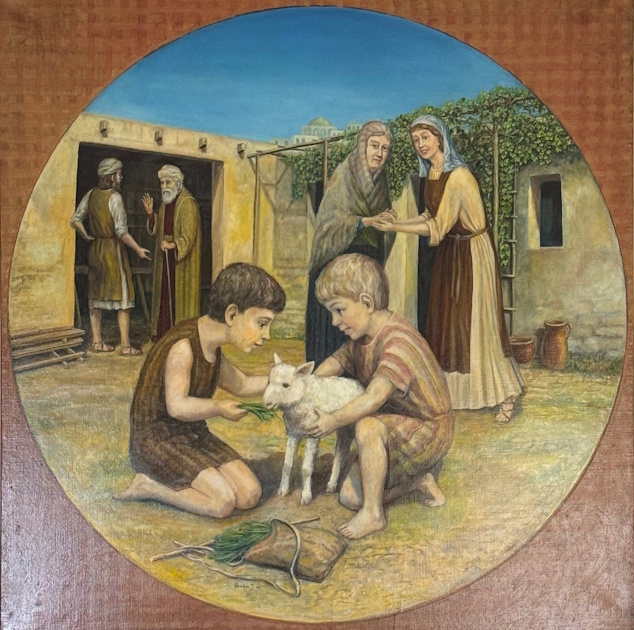
Jesus visits John the Baptist with His parents, Mary and Joseph. Jesus and John are in the foreground feeding a lamb, whilst their parents are catching up.

Click image for larger view
Year: 1990s
Medium: Oil
Location: Carmelite Monastery Melbourne
St Joseph from Nazareth is spouse to Our Lady and adopted Jesus as his son. He is a carpenter by trade and taught Jesus woodworking as he was growing up. St Joseph is the patron saint of workers and of the Auxilliary group who are Friends of the Carmelite Nuns in Kew.
Sister Marie de L’Eucharistie, OCD
Click image for larger view
Year: Sr Marie de L’Eucharistie, OCD (1896 – 1969)
Medium: Oil
Location: Carmelite Monastery Melbourne
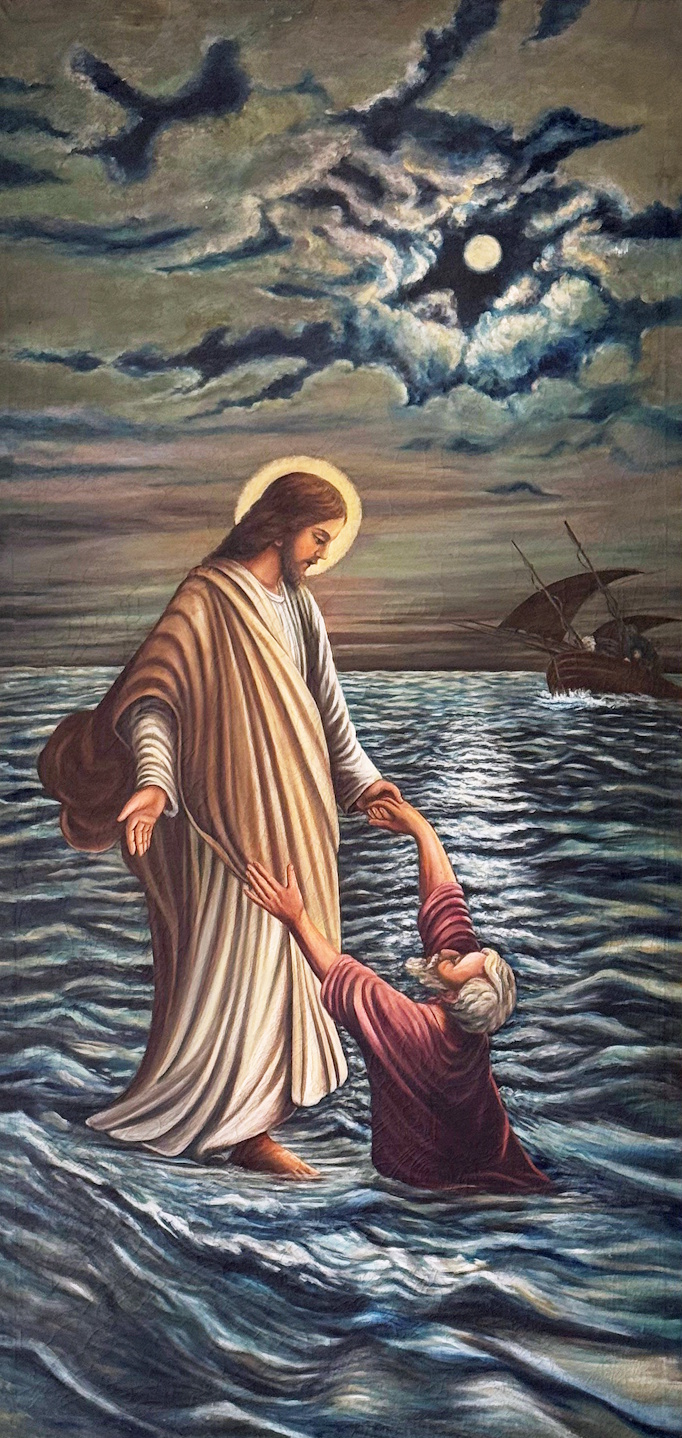
Peter walking on the water
(Matthew 14:22-23)
Christopher von Keisenberg
Click image for larger view
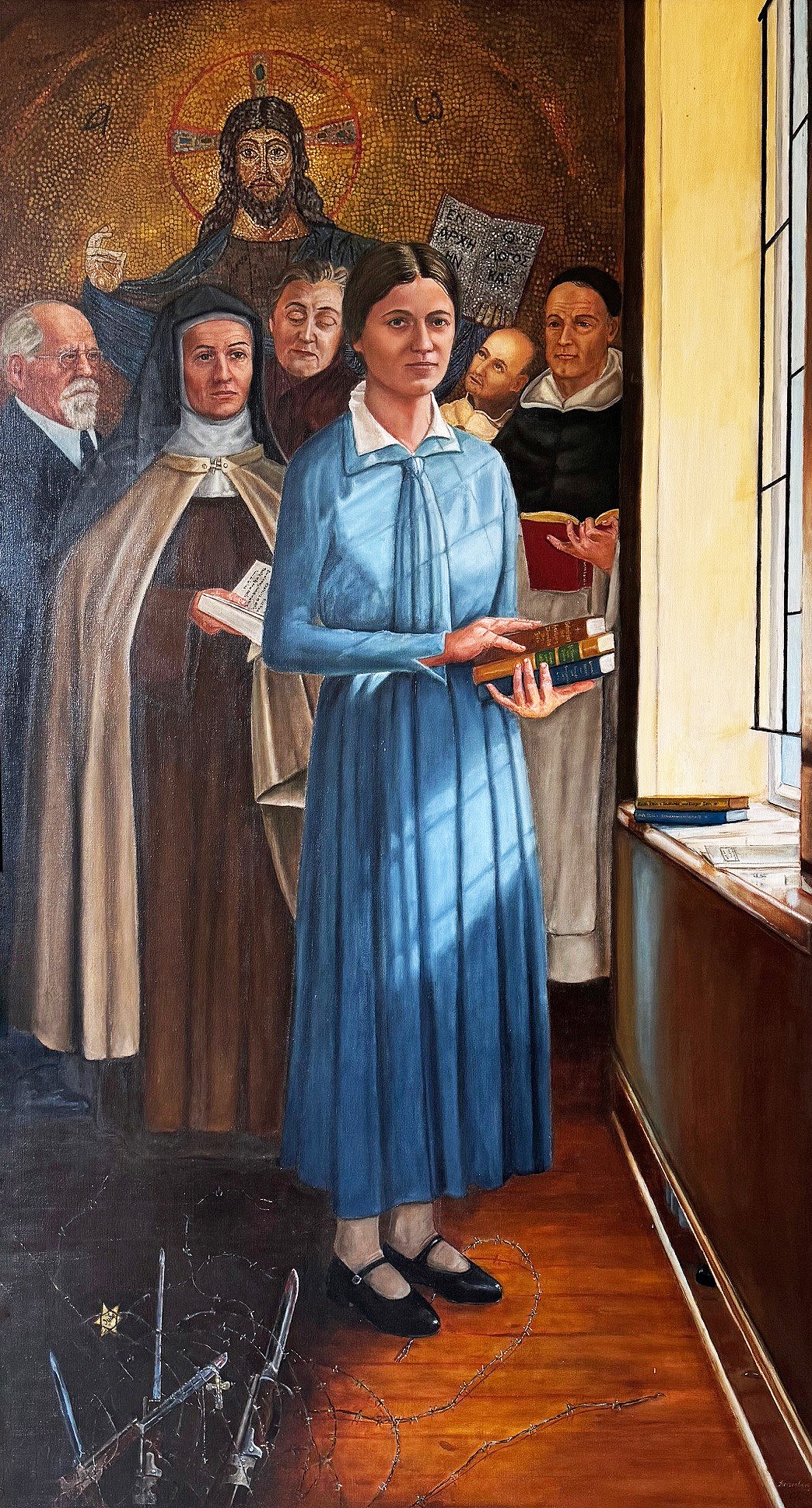
Dialogue of Reason: S. Teresa Benedicta a Cruce, OCD
by Christopher von Keisenberg
Medium: Oil
Size: 183 x 101.6 cm
Location: Carmelite Monastery Melbourne
The light of God streams through the window, which in turn is reflected softly in the mosaic depicting Christ the Pantocrator arching above all. Edith Stein, in the forefront, is bathed in light.
She is surrounded by figures that have had strong influences on her life. From left to right:
- Edmund Husserl, mathematician and philosopher. Stein was his assistant.
- St Teresa of Avila holding the poetry of St John of the Cross. The book in her hand is open at his poem, ‘In the Beginning was the Word’. It was reading St Teresa’s Autobiography that led Stein to convert to Christianity and Catholicism.
- Rosa Stein, Edith’s sister. Rosa also converted and accompanied her sister into the Carmelite Convent. Rosa never took vows and remained a laywoman. She was also taken with Edith to Auschwitz and died with her.
- St John of the Cross, mystic and poet, who supported St Teresa of Avila in the reform of Carmel.
- St Thomas Aquinas who is holding the Sententiae of Peter Lombard.
Edith is holding three books:
- The Collected Writings of St Teresa of Jesus (Avila).
- Aquinas’ Summa contra Gentiles.
- The Formal and Transcendental Logic of Husserl.
On the window sill in the light are three works by Stein herself:
- Finite and Eternal Being: An Attempt to Ascend to the Meaning of Being.
- Science of the Cross.
- The Ethos of Woman’s Vocations.
At the bottom end of the painting is the barbed wire and blood-stained bayonets, which are symbols of martyrdom, with the light catching the Cross and the Star of David. Edith is standing on a strand of barbed wire which is intended to recall the Virgin Mary’s trampling the serpent under her foot.
Christ the Pantocrator (Almighty), holds a Gospel in his left hand while blessing the scene below with his right. The words of St John’s Gospel, ‘In the beginning was the Word and…’ is in Greek: alpha (α) and omega (Ω) signifying the beginning and the end. The Greek symbols are depicted in the cruciform of Christ’s halo. The book in St Teresa of Avila’s hands is showing a poem by St John of the Cross reflecting on the same verse of St John’s Gospel.
This painting breaks the rules of time and space, depicting people who were not contemporaries and the space of the room in which Edith stands merges into another space of the mosaic in the background. A spiritual understanding of time and space may help one to perceive and cope with suffering. The interconnectedness of all things in space and that time is a linear progression helps an individual to have a deeper understanding of suffering within a larger context, thus fostering resilience and spiritual growth which transcends suffering. All finds its meaning in Christ, summed up in the Alpha & Omega symbols, transformed and illuminated in Him.