St Teresa of St Augustine and Companions, Martyrs of Compiégne

BORN: c. 1715–1765 (various dates)
DIED: 17th Jul 1794
It is sad to think that they were denounced by the postmaster on June 21st 1794, arrested and locked in a temporary prison which had been the convent of the Visitation. Three weeks later they were transferred to Paris, judged and condemned to be executed that same day, on 17th July.
Singing hymns as they were lead to death
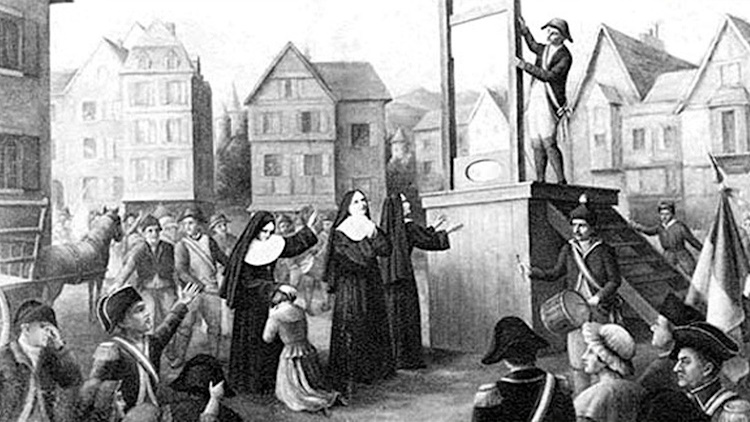
Events moved fast and the sixteen nuns were hustled off in open tumbrel carts to the place of execution that summer evening, singing as they went: Psalm 50, the Salve Regina, an anthem sung to the Blessed Virgin at Night Prayers, and the song of praise, the Te Deum. The hymn to the Holy Spirit, Veni Creator Spiritus, was chanted as they renewed their vows this last time before going to the scaffold. The familiar words had never meant so much.
Among the group two were seventy-eight years old and the youngest, Sr Constance, was twenty-nine. She had not been allowed by the new laws to make her vows until this moment, and she was the first to go forward and mount the high steps; then placing her hands in those of the Prioress, she vowed her life and sealed her sacrifice.
Martyrs – True witnesses to higher love
One by one they climbed the steps, one fainted earlier on hearing the sentence but took courage now. The eldest nun addressed the executioners and said, “I forgive you, my friends,” then she continued: “I forgive you with all that longing of heart with which I would that God forgive me!” Sr Henriette offered to stand beside the Prioress and assist her as she blessed each Sister until the singing voices stopped and stunned silence fell upon the bloodthirsty crowds. Such acts of supreme self-oblation, consideration for the others, calm in overcoming terror and the ultimate giving of life for one’s friends, made their offering complete, true witnesses to higher love.
Ten days after this terrible massacre Robespierre himself was executed and so ended the worst horrors of this reign of terror by preparing a way for peace.
Sr Marie of the Incarnation
The one missing member of the Community that day was Sr Marie of the Incarnation who was in Paris dealing with family business matters. She was the one who had most claim to royal blood and would surely have been singled out for execution had she been present. There was providence in her escape because she was later able to write an account and fill in some of the missing information about the community, who were never enemies of the state, but faithful in their beliefs over many years.
Thanks to the English Benedictine Nuns
There was also another group of English Benedictine Nuns in the Paris prison with the Carmelites and they managed to rescue some of the clothes and relics which they later took back to Stanbrook Abbey. In 1994 on the second centenary of the martyrdom they presented these to later successors of the Compiègne community.
Re-enactment
This dramatic and moving account of historical events caught the imagination of authors like Georges Bernanos in his drama and Gertrude von Le Fort in her novel “Song of the Scaffold; likewise of composers like Francis Poulenc whose opera “The Carmelites” is performed around the world and Jean Françaix, whose Suite for Organ based on musical sketches of the individual Nuns evokes their characters. We see a hidden power unfolding in human strength and manifest in weakness that is stronger than evil forces.