St Titus Brandsma

BORN: 23rd Feb 1881
DIED: 26th Jul 1942
Titus held the title of Professor of History of Philosophy and Mysticism at the University of Nijmegen where he became Rector Magnificus. His own definition of mysticism was
“a special union of God with the human being, whereby the latter becomes conscious of God’s presence and seeks to be united with God.”
(Dutch Catholic Encyclopedia Vol. VIII, p. 199 ff.)
Titus would never reject the world even at its worst crisis but could find good wherever he was. His gentle smile hid an inner strength and assurance born of love.
Beauty in its many facets appealed to him and the Blessed Virgin Mary was its perfect expression – hence the series he wrote on the “Beauty of Carmel’ about the history of the Order and its imagery. In St Teresa of Avila, he discovered a lifelong friend and continued to write on her even when he was in prison and had no paper but only the space between the lines of a book.
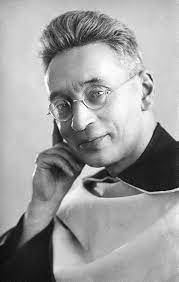
In the 1930s there was turmoil in Europe, the Spanish Civil War and ruthless Nazism followed by the invasion of Holland in 1940. Titus used his Gold Train Pass to travel through the country as official advisor and director of Catholic journalism, never afraid to speak out against Nazi propaganda. He was well aware this was a dangerous role and when he arrived home at the Priory on 19th January 1942, he had two visitors from the Gestapo waiting to take him to The Hague for questioning.
Up till now every day was packed with duties and time was short, but pushed and locked in prison at Scheveningen, comfortless and alone, he began to laugh.
“To think that at my age, 60, I am a prisoner! I have my own cell. I am no longer needed except for interrogation.”
Yet a Carmelite is never alone, and nothing could separate him from God. He made a little altar in this tiny space, where he prayed, wrote, and reflected. “Take the days as they come, the good with a grateful heart, and the bad for the sake of those that will follow, because misfortune is only a passer-by,” was his motto.
The grey cell was also a place of encounter and intimate contact with Jesus. Total surrender — in St Teresa’s words: “Those who have God lack nothing.” The day came when he was taken without warning to the notorious concentration camp of Amersfoort. Death loomed all about, but he still tried to ease the suffering of others and found ways of showing Christ’s compassion. At Dachau the camp of no return, he found consolation in a young Carmelite Brother, Brother Raphael, and four other Polish Carmelites who would sometimes share a prayer together. But death was not long coming and Titus died of a fatal injection on 26th July 1942. His ashes were buried in the Grave of Unknown Thousands. In the night of suffering, Titus encountered the divine and what he left afterwards was graced with peace.